
By Goglio P, Tosti G., Sorini S.
Legumes are so much more than just a protein source—they’re quiet powerhouses in our fields. From enriching soils with biologically fixed nitrogen to boosting biodiversity and resilience, they bring a whole suite of ecosystem benefits. As part of the legumES project, we’ve been following three very different farms across the Mediterranean to see how legumes perform under real commercial conditions. Here’s a glimpse of what we’ve observed so far.
Lentils in Rotation: A Strong Start on a Large Arable Farm
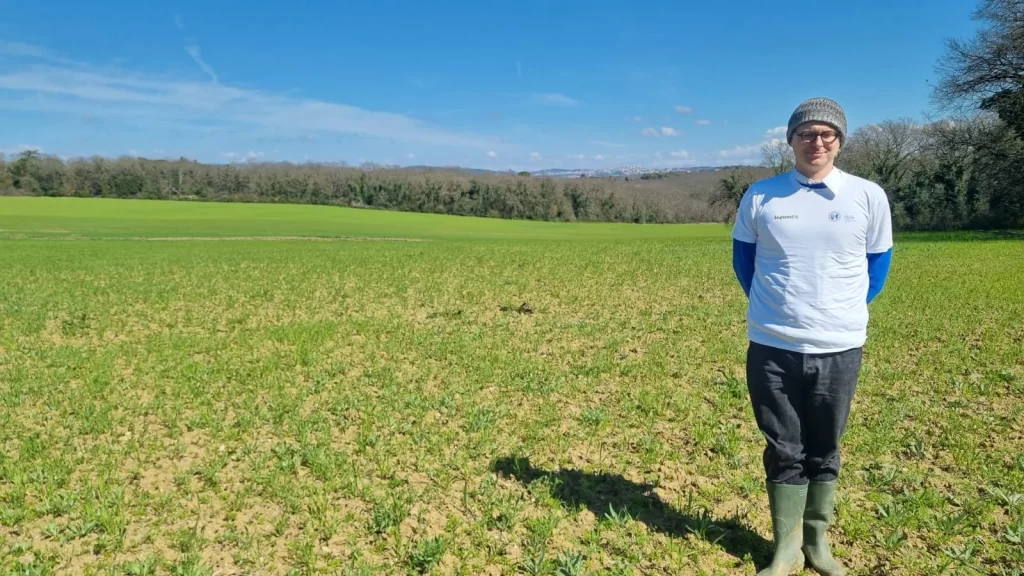
Our first stop is a large 1,800hectare arable farm run by the Foundation for Agricultural Education. With an impressive mix of crops, including lentils, chickpeas, fresh peas and beans, this farm offers a perfect testing ground for legumes in rotation. Last autumn, lentils were introduced into a maize–wheat rotation on loam soil. After assessing soil structure using VESS, they were sown on 19 November 2025. By midMarch, the lentils were thriving, covering more than 80% of the field surface, a strong early indicator of good establishment and crop health.


Hairy Vetch Cover Crop: Promising Growth Despite Challenging Soil
Our second participatory farmer manages a smaller 25hectare conventional farm. Keen to cut back on fertiliser and improve sorghum yields, he sowed hairy vetch as a cover crop in late October. The field is a tricky one: a clayloam soil with plenty of stones and shallow bedrock just 50 cm below the surface. Yet, despite the challenges, the hairy vetch established well, covering about 90% of the field. A slight unevenness in growth hints at soil moisture differences during sowing, but overall, the cover crop is looking very promising.
Chickpea–Wheat Intercropping: A Valuable Lesson for Organic Systems
The third farmer in our network runs a 140hectare organic operation, selling prepacked flour and grains directly to consumers. It’s a smart, valueadding strategy which helps to buffer lower yields typical of organic farming. For the legumES trial, he opted to sow chickpea and wheat together to boost soil fertility and enhance the resilience of the field ecosystem. Sown on 4 November 2025 in clayloam soil, the intercropping unfortunately didn’t establish well. With just 40% ground cover by March, the crop is unlikely to perform strongly, and in an organic system, low establishment can translate into significant yield losses. Even with a strong business model, this highlights how important successful early growth is for mixed systems like these.
What These Early Observations Tell Us
Across the three farms, one message is clear: thoughtful cropping system design and good management practices are essential when integrating legumes into Mediterranean farming. While some crops, like hairy vetch and lentils, are already showing very promising results, others remind us how sensitive systems can be when conditions are not quite right.
These are still early days, but seeing these practices implemented on commercial farms is incredibly encouraging. The data we continue to gather through legumES project will help refine these approaches and support farmers across the region in making legumes a successful, resilient part of their cropping systems.