
How the legumES Project Is Transforming Rural Education in Northern Extremadura
By – Elisa Pizarro Carbonell
What happens when cutting-edge ecological research connects directly with rural classrooms?
In northern Extremadura, Spain, the legumES project is showing just how powerful this connection can be.
Over the past year, the Aprisco team has been working hand-in-hand with teachers and primary school students from San Martín School (Garganta la Olla) to co-create an educational experience with the common thread of legumes, agroecology, and the ecosystem services they provide. The result is a living, evolving programme that blends scientific research with community learning, designed by and for the people who depend on these landscapes every day.
Bringing Science Back to the Territory
This initiative is part of the Farmland Biodiversity for Rural Wellbeing (BiodivRURAL) living lab, which aims to innovate how ecological knowledge is shared with rural communities. One of the core missions of Aprisco is to promote ecological research in northern Extremadura, while ensuring that this knowledge directly benefits the people who host these research landscapes.
Too often, rural areas serve as important scientific study sites without receiving accessible knowledge in return. So, legumES seeks to change that by improving ecological literacy and empowering local people through knowledge sharing and cocreation.
Designing a Learning Experience Around Legumes
Together with San Martín’s teaching staff, the Aprisco team codesigned a full academic year programme using legumes as a unifying theme. This included the following.

1. An Educational Experimental Garden
A 2×5 m garden was installed at the school, mirroring the format of Aprisco’s long-running Crop Diversity Experiment, which examines the mechanisms and benefits of mixed cropping versus monoculture. At the school level, the team focused on legumes and cereals, replicating the field design and data collection process, adapted to the needs of teachers and students.
2. Science in Action
During a visit to the Aprisco Experimental Station, students used real research tools, including light meters, chlorophyll meters, and soil moisture sensors, to understand how scientists study the ecosystem services of wild legumes, with a special focus on broom, a keystone woody legume species in the Dehesa (an ancient agroforestry-based system).

3. A PlantFamily Diversity Garden
A second, smaller garden (1×4 m) was planted to help students learn to identify different plant families, from legumes to linaceae (or ‘flax’ family) – supporting hands-on botanical learning.
A Growing Community of Participation
The project quickly expanded beyond the garden beds. Throughout the year, the school community embraced the programme through activities including:
- cross-country collaborations between Spanish and Scottish students;
- a village-wide chickpea-based meal, celebrating local cuisine;
- a collaborative legume recipe book, co-created by families; and,
- continuous observation and care of the school gardens.
These activities blurred the boundaries between school, family, and village, deepening local connection to the landscapes and crops that shape everyday life.
Listening, Reflecting, Improving
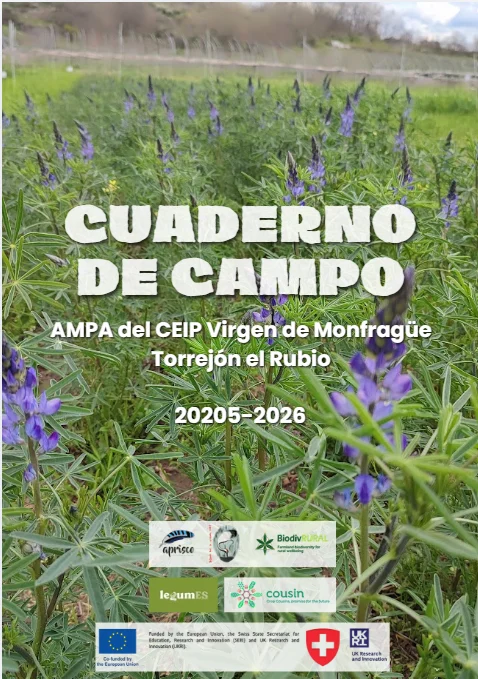
The year concluded with a World Café, where students and teachers shared what they enjoyed, what challenged them, and what they hoped for next year. Their feedback guided the codesign of a new field notebook, and improved educational resources for 2025–2026.
Scaling the Initiative Across the Region
Following the success at San Martín, the programme has expanded to three more educational centres, these are:
- CEIP Jeromín (Cuacos de Yuste): New gardens planted in December 2025, now including lupins.
- Torrejón el Rubio: Developed in collaboration with the local family association; activities extend beyond school hours and engage children from across the village. Plans include a “plant family diversity” garden at the Bird Centre to link ecology with rural tourism.
- Instituto Maestro Gonzalo Korreas (Jaraíz de la Vera): Integrated into an educational innovation project involving 14 teachers across subjects from economics to Greek to entrepreneurship. Students aged 14–16 explore curriculum topics through the garden.
Across all centres, Aprisco provides ongoing support, sharing notebooks, garden plans, and activities inspired by San Martín – all while celebrating the creativity and initiative of local teachers.
Why This Matters
The legumES project is demonstrating that:
- knowledge is a tool for empowerment:
- ecological literacy strengthens biodiversity conservation;
- rural communities deserve direct access to – and participation in – the science conducted around them; and,
- a cocreative community of researchers, teachers, families, and students fosters lasting ecosocial change.
By connecting agricultural research with education, legumES is nurturing not just gardens, but understanding, collaboration, and a sense of belonging to the landscapes that sustain rural life.