
How the legumES project Is Inspiring the Next Generation of Food System Thinkers in Portugal
By Anissa Davel
Over the past year, researchers at UCP-Porto have been bringing legumES to life through a series of creative educational activities across Portugal. These initiatives share a common goals:
- to reconnect young people with the food system;
- to show them why legumes matter; and,
- to build the ecological literacy needed for a sustainable future.
Working closely with teachers, chefs, community organisations, and most importantly, students aged from 6 to 18 years – the team has turned complex concepts like ‘ecosystem services’, ‘sustainable diets’, and ‘planetary boundaries’ into hands-on, memorable learning experiences.
🌱 Learning About Legumes: from Ecosystems to the Kitchen in Leiria
In partnership with the Brave Generation Academy (BGA) and Leiria’s restaurant Kukicha, the team created a three part series called Learning About Legumes. The programme introduced learners to the science, culture, and creativity behind legumes.
- Understanding Our Food System: Students explored planetary boundaries, ecosystem services, and the key role legumes play in sustainable agriculture. This sets the foundation for understanding why legumes are central to a more resilient and equitable food future.
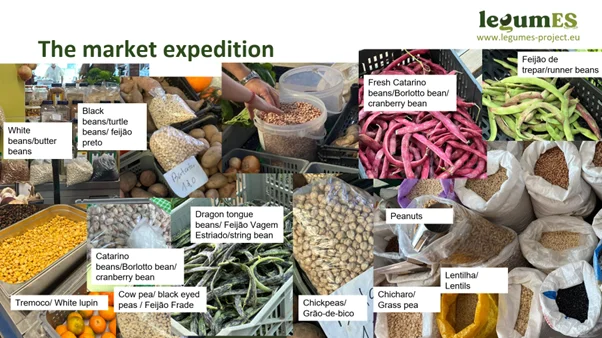
- Market Mission: During a visit to Leiria Municipal Market, learners interviewed vendors, searched for fresh and dried legumes, and discovered far more diversity than most expected. Many commented that they had never realised how many types of legumes exist.

- Kitchen Kickstart: A cooking workshop at Kukicha revealed legumes in surprising ways, from whipping aquafaba into chocolate mousse, to preparing chickpeas from scratch for authentic curry. Students gained practical food skills, including safe pressure cooker use, spice blending, and core kitchen techniques.
- MasterChef Challenge: The series culminated in a spirited cooking competition. Students crafted legume based dishes, Persian soup, Taiyaki, and more. Plus, they presented these dishes to parents, and peers for tasting, and feedback. What stood out most was the emotional connection many learners expressed, some recreated dishes from childhood and linking legumes to memory, culture, and identity.
Focus group reflections showed that:
- hands-on activities made information “stick”;
- cooking boosted confidence and curiosity; and,
- and many began experimenting with legumes at home.
🌿 Exploring Ecosystem Services Through Creativity in Famalicão
At the Centro Social de Bairro EcoSchool, developed in collaboration with the LeguCon Project, legumES researchers engaged 90 primary school students in a lively World Pulse Day activity.

Students learned what ecosystem services are, identified the benefits provided by legumes, and mapped these onto a basic illustration of a legume plant – which they then decorated themselves. The colourful results form a collection of works entitled, “Our Legume Plant” – and which are proudly displayed at the school. Teachers highlighted how meaningful and transformative the activity felt.
- “The children loved it and revisit the book often.”
- “I had never taught ecosystem services before, now I will include them.”
- “The activity awakened students to collaborative learning and brought new perspectives into our teaching.”
This session became a powerful example of cocreation: the activity design was improved thanks to teacher insight, while researchers provided the scientific backbone. Both groups agreed, true outreach depends on collaboration.
🍽️ Inventing the Food of the Future
The legumES project also played a key role in UCP’s national ‘Inventing the Food of the Future’ competition. High school students from across Portugal were challenged to design recipes that considered environmental, nutritional, and socioeconomic impacts. One of this year’s themes was “Luminous Legumes.”

The finalists impressed the judges with:
- a grass pea dip inspired by local culinary traditions;
- chickpeas and lupin as centrepieces of savoury dishes; and,
- the winning lupin and orange cake – which used every part of lupin seeds – even hulls transformed into a granita – and aquafaba.
The event showcased how legumes are culturally rooted, innovative, and exciting – not just a side dish, but a star ingredient of the future.
💬 Why Knowledge Sharing Matters
Knowledge Sharing takes time, creativity, and care, but it is essential. Through interviews, workshops, and feedback sessions, recurring themes have emerged.
- Many students had never realised what a legume is, and how important they are.
- Teachers often had never included ecosystem services in their curricula until these activities.
- Learners expressed a desire for more knowledge, not less.
- Simple, hands-on activities often had the greatest impact.
Knowledge Sharing is the bridge which adds value between information and culture. To help realise more-sustainable food systems, people need more than facts – they need meaningful experiences, experienced as a community, and which help build awareness the relevance of crop-diversity to every-daily life.
As Anissa put it:
“Improving food systems is fundamental to planetary health. Education is how facts gain meaning, and how meaning becomes action.”
A Shared Effort Toward a Sustainable Future
The legumES project is showing that when researchers, educators, chefs, families, and young learners work together, something powerful happens food becomes not only nourishment, but knowledge, culture, creativity, and connection.
These educational activities reaffirm that legumes are more than crops – they are catalysts for learning, community, and transformation.